

We've had a hard forty or so hours of relentless wind which seems, this calmer blue sky morning, to have swept everything clean. Last night a few clouds raced over the full moon like frantic commuters late for a train. A couple weeks of very warm February weather confused the earth: bright yellow daffodils were nodding their goofy heads, oblivious to Black History Month. Now it appears the daffodils held tight during the mighty sweep of wind; the gray brown winter land is dotted with the yellow yolks of flowers.

frozen river

Though people who've lived here long lifetimes can only recall a handful of times where the New River froze, it was just a few years ago that the "Polar Vortex" passed through and locked the river down. I wrote about it in these poems published in the anthology NEW RIVER REFLECTIONS:
The River At January
Polar Vortex
Powerless
The dog and the cat
have found puddles
of sun to curl within.
They are making do
in a house so cold
that ink won’t flow.
Hunkered In
Brittle blue sky
bereft of birds.
Not a boat
afloat on the river,
nor a deer
nuzzling the paralyzed
orchard grass
for the last
autumn apple.
Rabbits, raccoons possum, fox
are nowhere
to be seen.
It is like
Earth
after
life.
Glacial
Ice floes glide
the river.
Arctic islands
heading for
West Virginia.
Holding
In the wake of the arctic wind
forest, field and brush are left
immobile, like crafty children
playing a game of Freeze Tag.
1-7-14

Mozart Limbs
Winter’s first snow today
turned all the trees to sycamores.
Powdered courtiers, elegant arms
offered in lines along the river:
ghosts frozen in a minuet.
1-21-14
The River on The Coldest Day
The End
Late sun molting
at the bend, with
a clatter like
tumbling rocks,
the river is cracking up.
1-24-14
The Beginning
We can’t believe our eyes:
Winter stopped the river
bound it bank-to-bank,
lashed it to the cliff feet
in crystal stillness.

The Way Sound Carries
The river has been solid for a week.
Our neighbor’s dog is missing. My
calling out for her reverberates in
the crystal air, the ground crackles.
Nothing moves—cloudless blue sky,
pale sycamore, snow, and gray rock.
No black dash of tail-wagging dog.
Gladys, from the general store, told
a story about the last time the river
froze over, way back in the 1980’s:
A doe, trying to make the crossing,
plunged mid-river, her hind quarters
in the sear of glassy water, her front
legs scrambling the ice for purchase.
Gladys said that all over town you
could hear the desperate wailing of a
living thing that did not want to die.
I am thinking about that doe when
the dog appears, all proud of herself.
She has been on an adventure and
has returned, clutching the hooved
foreleg of a deer between her teeth.
Costa Rica with Iris

We’re in an infinity swimming pool high above the Pacific, mountains in the distance. Iris plays a favorite song for me on her pink cell phone and, on the roof of the pool house, a large blue iguana rocks out in time to the music. We’re here because, for her graduation present, Iris wanted to see a sloth. On our first day, as we walked a steep path down to the ocean, we almost bumped into a sloth making his furry, three-toed way down a wide-leafed tree. He settled at the base and then, after his bathroom break, began his 5 minute slo-mo climb back up into the tree branches. A sloth descends to the ground once a week to make potty. His toilet was our magic moment and Iris caught it all on video. On that same walk to the sea, white-faced monkeys did monkeyshines in low branches over our heads. A bullyboy (Roy Moore?) monkey insistently pulled the tail of a smaller white-faced monkey, she evaded. Squirrel monkeys cavort across our deck and at dawn we hear the call of the elusive howling monkeys.
A morning’s walk to breakfast revealed two sloths high overhead and camouflaged by leaves, a flock of small green parrots, and the carnival flight of large multicolored ones; an aguiti crossed our path with a long-limbed amble. We’ve seen macaws, hummingbirds, butterflies, a small shiny black bird with a royal blue crest and a two-toed sloth with her baby clinging to her belly.

While Rick worked at the computer in Saturday’s afternoon shade, Iris and I went body surfing on the long pale stretch of public beach, and—back at the resort—made a poolgrimage: We visited (and swam in) all five swimming pools hidden in the jungle of this 30-some acre rainforest resort. After supper (Iris’s vegan, my plantain shrimp tower and Rick’s roasted snapper) we three went to a small local bar perched on a rickety deck above the sea and forest. A dad twirled his blond barefooted three-year old daughter like a flaming baton, tossed her in the air, caught her, and then flung her over to her mom so he could pick up his guitar and be the 2nd in a two man band, performing with Greg Altman’s ancient double—both of them really good and playing songs where Iris knew all the words. At the third song, a silver-haired black man impulsively left his table of ladies to pick up a set of bongos and create a rock n’ roll trio; he grabbed two beer bottles and banged them together for extra percussion. He was apparently moved to join the two musicians he’d never before met. They were still jamming when we left the bar with sleepy Iris.

The three of us had gone early Saturday morning into the national park rain forest with a guide and saw more creatures, flora and fauna, than I could ever hope to remember (or spell). But we learned about “The One Day Moth” that goes through the usual cycle: larvae to caterpillar to chrysalis to gorgeous winged created. This moth is born with no mouth and has but one day to mate before she dies. The metaphor is overwhelming. Then our guide told the story of a never-to-be-forgotten ‘stay at home dad:’ a small male frog who watches after the larvae the female has abandoned and, as the tadpoles begin slowly to appear, he loads them—one at a time on his back—and climbs a long flower stalk to deposit each infant tadpole into the water-filled tube of an orange flower. Dad then goes back for the next and the next, until all the infant tadpoles have been deposited into individual flower floating incubators. Their species are cannibals and if the tadpoles were left to mature together, the siblings would devour one another. There is probably another metaphor in there somewhere.

Sloths have a damp green fungus, on their bellies, inhabited by little beetles that ride down the tree for that once-a-week bathroom visit and lay their eggs in the sloth poop (then quickly hop back on for the plodding upward return), thus perpetuating their species. A lot of stuff going on in these rain forests.
the colors of the cliffs

We built our riverside house on an amazing piece of land paid for by the publication of Midnight Lemonade. It faces the Eggleston Cliffs, also known as The Palisades. The design and materials of the house aimed to blend with—rather than intrude upon—the towering stone ridge rising above the second oldest river in the world. Someone recently asked if I could describe the colors of the cliffs:
The cliffs—without any play of light—are granite gray with drizzles of darker gray and black. They are ridged and, perhaps like the rings in a massive felled tree, the ridges represent time. Maybe each ripple ten million years, or a hundred million?
In summer the gray recedes, leans away from the river to nestle into open limbs of green, all the greens of summer: apple green, forest green, mint, pine…. The cliffs reflect on the clear surface of the river so perfectly that it is difficult to separate the real from the reflection.
The autumn cliffs appear closer, moving through the warmth of leafy flames, deep maroons, reds, and bright yellows, orange. And as the leaves blow or fritter away, the cliffs come even closer, become grayer. The river nudges the feet of the cliffs with a rusty crust of floating leaves.
During winter the sheer stone is very close and seems higher, prison gray except when the snow comes. Depending on how long it snows, and how light the snow, the cliffs might fancy themselves up with flouncing ruffles of lace. If the snow is heavy, the cliffs turn Viennese, become gigantic dark pastries mounded with fluffed sugar frosting. Winter turns the river a deep shade of jade.
Spring sprinkles the cliffs, breathing pale green vapors into the contours, and then startles with redbud pinks and wild cherry whites. When spring storms are not swelling and browning the river, it ripples below the sheer stone like pale tinted bottle glass.
Near sunset, on a day of sun—no matter the season-- the cliffs amaze and never ever hold the exact same colors. We have seen sea shell pink and oranges more vivid than autumn’s pumpkins, maple and poplar trees. We have seen lemon yellow, blood red, shimmering pale blue, azure, indigo; golds so bright that they light up the inside of our house.

Goner goes NOLA

It was not without reluctance that the wonderful Octavia Books in New Orleans agreed to host a reading of GONER. I fully understood owner Tom Lowenburg’s hesitation. That lovely little bookstore, tucked a few shady blocks off Magazine Street, sponsors several readings a week, many of them for the literary giants of our times. Jesmyn Ward read at Octavia ten days before I did. It makes me light-headed to even think that I leaned my forearms on the very same podium. Ward’s two latest novels SALVAGE THE BONES and, now, SING UNBURIED SING are the best of the maybe twenty really good novels I’ve read in the last five or six years. Independent bookstores, understandably, don’t care for books only carried by Amazon. At Tom’s advice, Melissa and Lynn got GONER into Ingram Spark Publishing with a brand new ISBN. Let your local bookstore know that we’ve seen the error of our ways and have mended them!

Whenever we drive down to NOLA, Rick and I leave the riverside about 5 in the morning and head straight from our house to Frankie and Johnny’s where the N.O. family always holds a table for us. No matter the time of year, the journey south and west bears witness to a slow change of seasons. This mid-November we made it from Appalachia’s damp grays and browns to the blooming fall blossoms of The City of Dreams (The ‘slow’ trip sped by as we listened to Hillary’s WHAT HAPPENED; some chuckles and tears amid the horror). We had eggs and granola for breakfast, glistening raw oysters and spicy boiled shrimp for supper.
A supper we would have willingly passed up, had we known that Mark Helprin—Rick and I share a passion for his writing—was reading at Octavia while we were slurping oysters! We would have dragged the family over and lined up like the Helprin groupies we are. The very well read (& deeply opinioned) guy behind the desk at Octavia told us that only about 8 or 10 folks attended Helprin’s Friday night reading. How could that be?

The next night, Saturday, different chapters of my life walked into the bookstore as the 6PM reading time approached. I was so delighted and so grateful. Where Helprin had an audience of 8 or 10, Goethe had 35 or 40! I could hardly summon my voice, looking out over a room of people who meant so immensely much to me: Of course my son Paul and his son Jay, grand daughters Alanah and Iris, and my ever stalwart Rick, but also friends I’d known since age five. Donaldsonville friends, boarding school friends, New Orleans friends, hand-me-down friends from my sisters; cousin Rodney from Bunkie and his literary son and daughter-in-law from Australia, their British friends. The crowd asked good questions and laughed in all the right places—as folks from South Louisiana tend to do.
Our dear friend Becky Lloyd not only talked Tom into letting GONER through the door of his bookstore (next door to Becky’s Yoga studio); she also hosted the after reading gala. Rick was, again, blending the frozen whiskey sours, grand daughters Iris & Alanah (OK, mostly Alanah) provided exotic vegan nibbles; all our fine Louisiana friends and a few Octavia patrons mixed and sipped and nibbled and reminisced. Oh happy night of my heart!

painted rocks project in Giles county

from a Giles County Early Education Project press release
The past two weeks in Giles County have been a flurry of fun, creative activity. The Giles Early Education Project (GEEP), Giles County School Board, and faculty and students have engaged in a massive and ambitious public art project. Lynn Hill of GEEP shared in an email that their plans are to have every child ages 4 through the 7th grade participate in the “Rock-Paper-Wizards” initiative.
Since November 2 GEEP has delivered buckets of rocks to all three elementary/middle schools in Giles as well as the early learning centers. The students and teachers, along with family and supporters have been creatively painting the rocks. The task from GEEP was to “paint a rock that in some way represents who they are.” The collective creative energy has inspired the School Board, staff, volunteers and others to join in the painting.
The GEEP members will collect all rocks on November 10 and shellac them for longevity. The group, made up of a cross section of the Giles community who hope to improve and provide avenues for positive development for young children in Giles will then install the rocks in a massive public art project sometime in the near future.
Those involved anticipate 2,000 students being involved from all parts of Giles County. The Superintendent of Schools along with the librarians and art teachers were supportive and influential in helping to spread the collective approach to the Rock-Paper-Wizards project. In the larger picture GEEP wanted to encourage positive habits through this project and they’ve added a literary component and have shared a list of books that will encourage creativity as youth paint their rocks about them. They’ve also encouraged youth to write something that shares their ‘uniqueness’ but also “how they might share their talents with others in their community.”
All partners hope that the project will meet an outcome of not only celebrating ‘me’ but also ‘us’ as a community. The Giles County community and educational providers continue to inspire learning and creative solutions for educating our youth.
remember that I am is a complete sentence

Giles County Courthouse, Pearisburg, VA
Along with our State senator and delegate and representatives from our two Federal senators, I was a speaker at the first "Drug Court" Graduation on October 10, held at the Giles County Courthouse.
My brief talk follows.
How wonderful and encouraging and terrifying that you have so many people who believe in you, who are looking out for you. Today brings that faith and hope, your bravery and endurance all together.
Judge Harrell asked that I find a poem to read for you today. I looked at a lot of poems and finally chose this one by Brad Aaron Modlin:
What You Missed That Day You Were Absent from Fourth Grade
Mrs. Nelson explained how to stand still and listen
to the wind, how to find meaning in pumping gas,
how peeling potatoes can be a form of prayer. She took
questions on how not to feel lost in the dark.
After lunch she distributed worksheets
that covered ways to remember your grandfather’s
voice. Then the class discussed falling asleep
without feeling you had forgotten to do something else—
something important—and how to believe
the house you wake in is your home. This prompted
Mrs. Nelson to draw a chalkboard diagram detailing
how to chant the Psalms during cigarette breaks,
and how not to squirm for sound when your own thoughts
are all you hear; also, that you have enough.
The English lesson was that I am
is a complete sentence.
And just before the afternoon bell, she made the math equation
look easy. The one that proves that hundreds of questions,
and feeling cold, and all those nights spent looking
for whatever it was you lost, and one person
add up to something.
Cody and James, there is so much faith in you in this room. Which won’t amount to anything if you don’t have faith in yourselves. Remember that everything adds up to something and that “I am” is a complete sentence.
the Blacksburg book launch
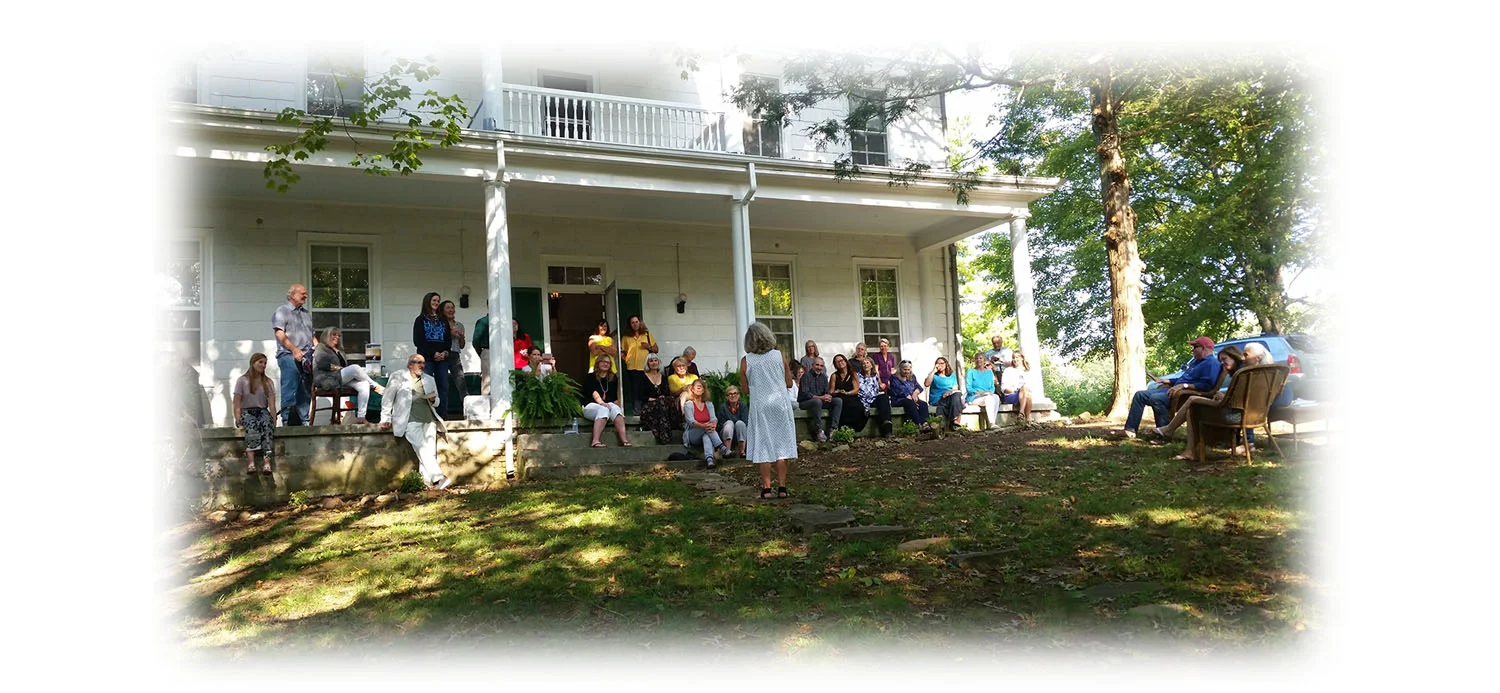
Ann Goethe reading from Goner at the Blacksburg launch party.
This is Diane Goff's introduction of Ann at the Goner book launch party in Blacksburg, VA.
We are here to celebrate Ann’s new book, Goner. We are gathered to celebrate Ann as a writer. But as life informs art and art informs life, I’d like to mention a few more things about Ann.
Ann is a mover and a shaker. Wherever Ann goes, change follows - Ann was the seminal person who created the New School, which is still alive and going strong, she wrote and directed many plays for young people here in the New River Valley and the kids from those plays still visit Ann when they come back to Blacksburg. The The New River Cleanup, Renew the New, was Ann’s idea and she has helped to transform many lives in Giles County with her inspiration and collaboration in so many different venues that she was named Outstanding Volunteer of her region.

Ann is the hostess with the most-ess. She and Rick consistently provide a lovely gathering place for groups as diverse as political meetings to family birthday river picnics.
Ann is a nature lover. You only have to read her book of poems, River Bow, to feel her deep appreciation and keen observation of nature.
Ann is a writer. Ann and I became friends while collaborating many years ago – my photographs illustrating one of her short stories. Since then we have been in a longtime and multi-layered collaboration of art forms including the group of friends and artists we have performed with over the years, Web Six, aka Loose Threads. Ann’s first book, Midnight Lemonade, came out to strong reviews and was a finalist for Barnes & Noble Discovery Prize. Her play, Coming of Age, was made into a film, she wrote the libretto for an opera performed by Opera Roanoke. Her work has been included in many literary magazines and journals and now, just when she had declared her writing life put out to pasture, here comes Goner. Looking at Ann’s life I’d say this is Karma coming around in this lifetime.

Ann Goethe and friends.
facts and fiction

Until this last week, almost everyone who has read Goner knows me and also knows my sisters. Friends and family have responded generously and positively to the novel, yet can’t help but read it as non-fiction: “I didn’t know your sister raised goats!” “When did you live in Mississippi?” “You have a rotten singing voice!”
It is true that I am one of four sisters and that we all spent our formative years in a very small town on the Mississippi River. Many of the adventures recounted in Goner are adventures we shared. The story, admittedly, does not reflect a huge stretch of authorial imagination. That said--I am most certainly a novelist, not a memoirist.
Each of my three sisters is a fine writer; and one of the three has been working for almost thirty years on a rich, lovely memoir about growing up on the River Road in South Louisiana. This sister is a wonderful writer, but not a ready decision maker, so she has lingered long over her book. Since both of us draw deeply from the same well, it has forced me think a great deal about the difference between fiction and memoir. Finally I have come to think it narrows down to this: A novelist sets out to tell a story and the memoirist to tell the story. In autobiography, it is only possible to know one’s own heart. A novelist can choose to know many hearts.
I had hoped my sister’s book would be ready when Goner was, as I think reading the books in sequence would be so interesting and would expand the market for both. But my sister is not one to rush the muse and so will be in the process of writing and deciding for the foreseeable future. Meanwhile I do, indeed, have a rotten singing voice, but Emily’s is just beautiful. Fiction can do that.
June 25, 2017
old woman’s anthem

When I was thirty I could climb to the top of a branching oak tree, compete in pogo stick races, and dance all night. My tanned skin was smooth, my eyebrows high, my hair glossy thick, and my three beloved children were precocious, funny unpredictable toddlers. Now, at seventy, I gaze longingly into low hanging branches, would no more mount a pogo stick than jam a knitting needle in my eye; I’m good for maybe three fast dances before oxygen deprivation starts in. At seventy, my skin looks like a wadded first draft retrieved from a waste basket, my eyelids sag low over my squinting eyes and my hair catches light like a frizzled halo. My five grandchildren--while surely precocious and funny—have not been toddlers for years. Yet I would not trade that thirty for this seventy for all the Portraits of Dorian Gray in the world. I look at my hands with their raised veins and age spots and literally grin. I made it, I think. Way too old to die young. These hands have lived! I’m still around to see how the story ends. In fact, I’m so old and wise, I know the story never ends.
When gathered round a table with my loud and interrupting-one-another-women friends, I want to raise a wine glass high and say: “We made it!” Think of the centuries before--right on down to our very own mothers --think what time did to women back then. If Patsy Cline had been born a couple decades later, instead of ‘walking in the rain, trying to forget,’ she would have ‘washed that man right out of her hair’ and hung out with some wild and raucous girlfriends. Poor darling.
I’ll admit, when I first became invisible, it was hard on me. For most of my life I caught an eye or two as I walked down the street or into a room. I had good luck hailing cabs and got really great seats in restaurants. Gradually people stopped looking my way and—after a while—it became necessary to wave to get a server over to my bad table or a clerk to wait on me at the hardware store. That repartee I so easily engaged in seemed to have disappeared. I mean, I still did my Dorothy Parker act with waiters and store clerks. But it made them back away. How could I possibly be funny? I was old! My peers were still amused. But, as an old person, I was about as funny to the young as a walking corpse, cracking bad “knock knock” jokes. Once, during Senior Discount Day at Kroger’s, to spare the clerk asking the obvious question about my elegibility, I gravely intoned: “I am an ancient one.” He almost rang for the manager in his horror. I felt sorry for him and he was terrified of me. I’d forgotten I was invisible. But, by the time I was fully in my sixties, I saw the fun and freedom of invisibility. I began to feel like Lily Tomlin in ALL OF ME.
I have a friend who can’t even say “old,” she calls it “the O word.” My brilliant friend is to this day a respected and prolific scholar and writer. She is older than I am and yet won’t even agree to dip a toe into the pool of aging. Don’t call my friend old and don’t offer to carry her groceries! She was a stunningly gorgeous young woman and that seems to have cursed her golden years. Smart as she is, she doesn’t understand how very valuable we are, no matter how we look. We often argue about this. I am urging her into the peace and glory of aging and she all but wears a necklace of garlic around me, as though I am a vampire threatening to suck away her young blood. To me young blood is like Dr. Pepper, while our old blood is like a fine Barolo.
True, we in the over-seventy set are prone to dementia, broken hips, failed gums, and crippling arthritis. None of it fun or pretty. It is harder to be delighted to have survived the fire in the belly and the wages of sin if you don’t recognize your own daughter, or won’t ever walk again. I’m not saying anyone should shout: “Yippee! Yipee! I live in a nursing home!” Nope. When old age gets hard, it is really hard. Those of us still gathering rose buds—wilted and scentless though they may be—owe our less fortunate sisters and brothers any bed of roses we can provide. We need to look out for one another and we need to keep dancing, even if we can only manage three songs, or so.
Quisque iaculis facilisis lacinia. Mauris euismod pellentesque tellus sit amet mollis.